
The modern Information Technology (IT) sector relies heavily on a vital bridge: the IT Business Analyst (BA). Software engineering teams speak in code, algorithms, and technical architecture, while corporate stakeholders speak in revenue, user experience, and operational efficiency. The IT Business Analyst serves as the critical translator between these two worlds.
If you are looking to pivot from a non-IT background such as sales, banking, customer service, or healthcare operations—or if you want to accelerate your current trajectory within tech, an international credential is your fastest path to success.
The International Institute of Business Analysis (IIBA®) offers a globally standardized roadmap. Their core credentials the Entry Certificate in Business Analysis (ECBA™), the Certification of Capability in Business Analysis (CCBA®), and the Certified Business Analysis Professional (CBAP®) provide the structural framework needed to secure high-paying tech roles.
This comprehensive guide breaks down these three tiers, analyzes the metrics for choosing the right path, and details how focused online training can launch your career in software development and IT consultation.
The Strategic Importance of the IT Business Analyst
In software environments, mistakes are expensive. A single misunderstood requirement can lead to thousands of lines of wasted code, delayed product launches, and blown corporate budgets.
This is why IT firms prioritize certified BAs. By utilizing the Business Analysis Body of Knowledge (BABOK® Guide), certified professionals bring structured processes to software development lifecycles (SDLC). Whether an organization utilizes Agile, Scrum, Kanban, or traditional Waterfall methodologies, an IIBA-certified analyst ensures that software products solve actual business problems.
[Business Problem] ──> [Certified IT BA (BABOK Principles)] ──> [Clear Software Requirements] ──> [Successful Tech Solution]
Choosing the correct certification tier depends entirely on your current technical familiarity and your practical experience in project environments.
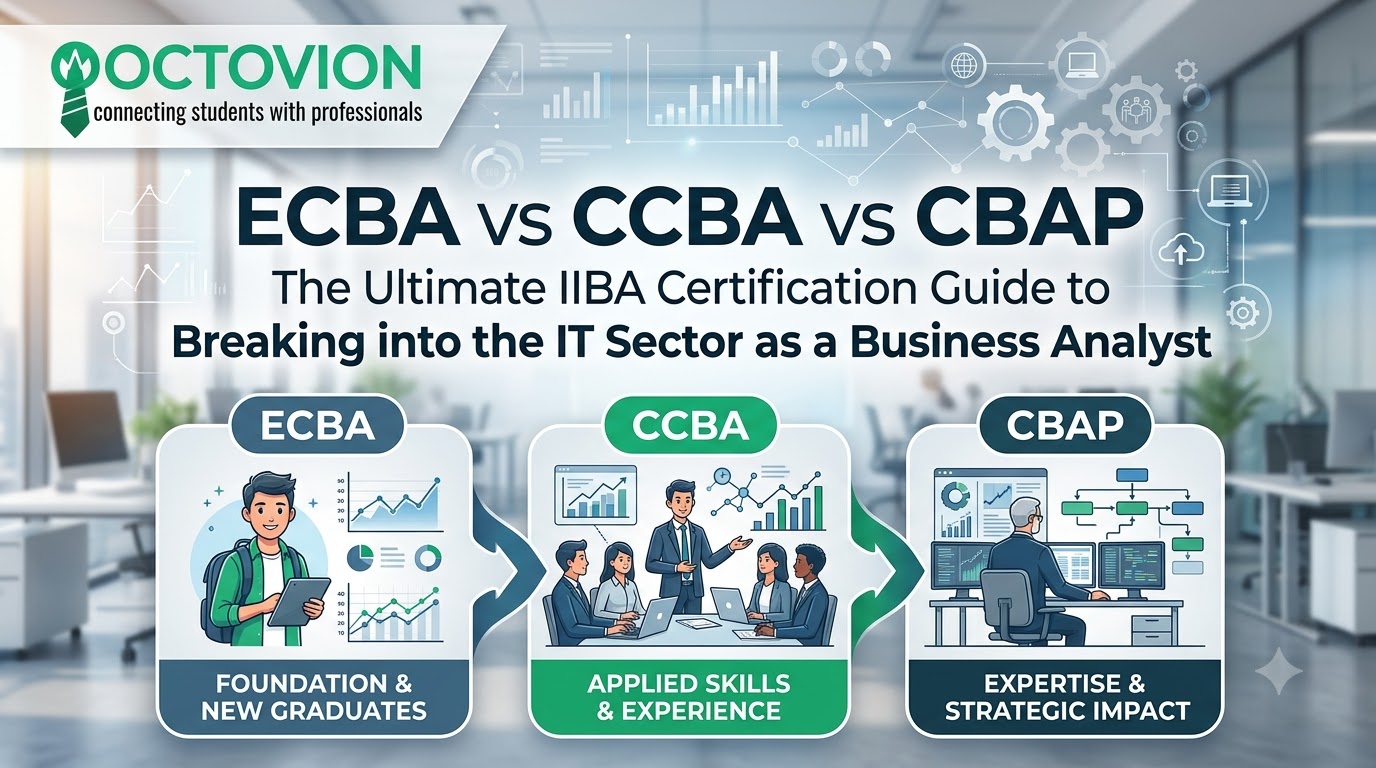
Breaking Down the Tiers: ECBA vs CCBA vs CBAP
1. ECBA: The Non-IT to IT Gateway
The ECBA is designed specifically for individuals with zero prior experience in formal business analysis. It tests your comprehension of foundational concepts without requiring hands-on work hours.
- IT Career Context: This is the ideal credential for career changers. It proves to technical hiring managers that you understand software requirements engineering, use case modeling, and data flow basics, even if your background is non-technical.
- Key Focus: Core terminology, requirements elicitation basics, and the structure of the BABOK Guide.
2. CCBA: The Intermediate IT Practitioner
The CCBA requires verified work experience. It is designed for practitioners who have spent a couple of years working on software delivery teams, mapping workflows, or supporting system implementations.
- IT Career Context: Perfect for software testers (QA), technical writers, application support specialists, or hybrid project managers looking to formalize their business analysis credentials and step into dedicated IT BA roles.
- Key Focus: Real-world application of BA techniques, managing the requirements lifecycle, and facilitating stakeholder workshops.
3. CBAP: The Elite Software Consultant
The CBAP is the highest core standard for business analysis globally. It requires extensive hands-on practice, proven leadership on large-scale software builds, and deep strategic expertise.
- IT Career Context: For senior IT analysts, enterprise architects, and product managers who design massive digital transformations, oversee cloud migrations, or lead multi-million-dollar software implementations.
- Key Focus: Enterprise design, strategic software tool selection, complex stakeholder negotiation, and structural business architecture.
Detailed Comparison Matrix: IIBA Certifications
| Evaluation Metric | ECBA™ | CCBA® | CBAP® |
|---|---|---|---|
| IT Career Target | Entry-Level Software BA | Mid-Tier IT Systems Analyst | Senior Enterprise Architect / Consultant |
| Required BA Work Hours | 0 Hours | 3,750 Hours (past 7 years) | 7,500 Hours (past 10 years) |
| Core Skill Requirement | Knowledge of BA concepts | Execution of software projects | Strategic leadership & optimization |
| References Required | None | 2 (Manager or CBAP holder) | 2 (Manager or CBAP holder) |
| Exam Question Style | 50 Knowledge-Based | 130 Scenario-Based | 120 Complex Case Studies |
| Exam Duration | 1.5 Hours | 3.0 Hours | 3.5 Hours |
| Application Fee | $45 | $145 | $145 |
| Exam Fee (IIBA Member) | $150 | $250 | $350 |
| Exam Fee (Non-Member) | $300 | $450 | $500 |
Transitioning to Tech: Overcoming the Prerequisite Hurdle
While the ECBA has no experience constraints, moving up to the CCBA or CBAP requires you to document your project history clearly. To successfully clear the IIBA’s application review, keep these core execution strategies in mind:
- Map Hours to Software Knowledge Areas: You must track your historical hours against specific BABOK Knowledge Areas. Focus heavily on domains like Requirements Analysis and Design Definition (RADD), which directly connect to outlining software features and application logic.
- Secure IIBA-Aligned Professional Development (PD): You cannot apply for these exams through self-study alone. The IIBA mandates verified training hours (21 hours for ECBA/CCBA; 35 hours for CBAP) delivered by an approved educational provider.
Accelerated Online Training Paths for IT Career Placement
Navigating the transition into tech requires more than just reading the BABOK Guide. You need hands-on familiarity with modern tools like Jira, Confluence, SQL, and visual wireframing platforms.
Octovion provides tailored, industry-aligned online training tracks designed to fulfill your IIBA educational requirements while preparing you to pass your exams:
For Beginners Seeking a Direct Entry into Tech
- Comprehensive Foundation: The Octovion Business Analyst Certification Online Training Course delivers a structured breakdown of software requirements engineering, agile methodologies, and visual modeling techniques. It helps you build a solid functional portfolio to stand out in technical interviews.
- The Non-IT Pivot: If you are actively looking to step away from non-technical roles, you can Grab This Golden Opportunity to Get Into the IT Sector. This program focuses explicitly on how IT projects operate, teaching you how to speak the language of developers, software architects, and tech leaders seamlessly.
Structured Placement and Certification Pathways
- Beginner-to-Advanced Strategy: The Career-Focused BA Training and Placement Course with ECBA Certification guides you systematically from zero knowledge to deep Agile and Scrum proficiencies. It includes built-in preparation for the ECBA exam alongside resume-building and placement support to jumpstart your career search.
- Industry-Aligned Upskilling: If you need a comprehensive approach that matches current tech sector hiring trends, the Comprehensive Business Analyst Training and Placement Course balances theoretical IIBA concepts with practical enterprise software case studies. It is highly optimized for professionals aiming for swift intermediate certification and direct placement in tech corporate structures.
Conclusion: Plan Your Next Move
The tech sector values domain expertise combined with structured methodology.
- If you have no prior tech experience, start with the ECBA to build credibility.
- If you are already working alongside IT projects, leverage the CCBA to secure a dedicated analyst title.
- If you are a seasoned software veteran, use the CBAP to command executive consulting salaries.
Aligning your training with experienced mentors reduces preparation time and ensures you meet the strict application standards of the IIBA. Explore Octovion’s targeted online courses to find a path that fits your current experience and accelerates your growth in the IT sector.